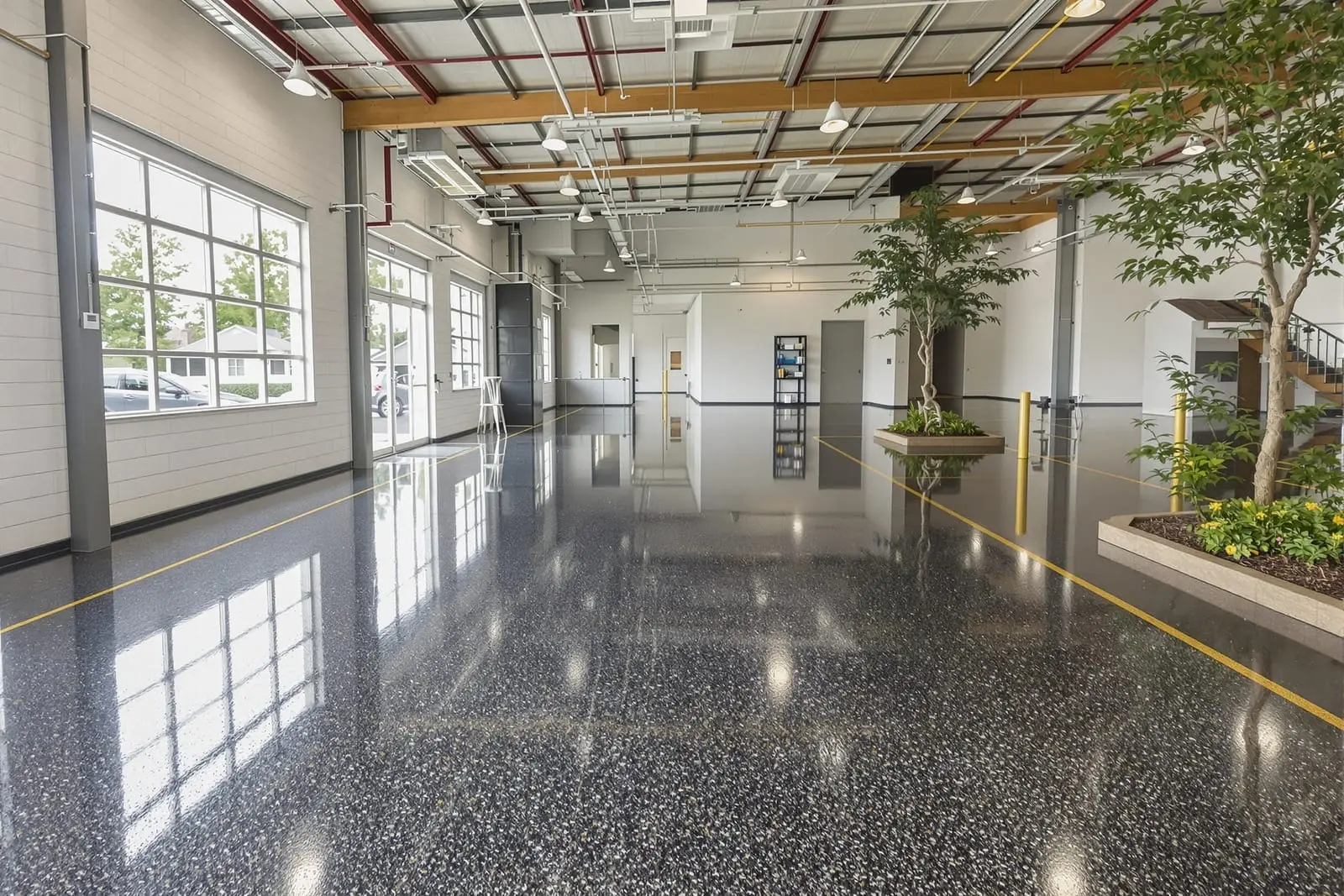
We install industrial concrete floors in St Louis, MO for warehouses, manufacturing plants, and distribution centers. Our slabs are engineered for forklift traffic, racking loads, and heavy machinery. Achieve flat, durable floors that reduce maintenance and support efficient operations.
Vanguard Concrete St. Louis provides professional industrial concrete floors throughout St Louis, MO and the surrounding area. Our licensed, insured crew delivers safe, clean, on-time work with a free estimate before anything begins. Call (314) 788-2998 or request your free quote.
Industrial Concrete Floors Built for St Louis Warehouses
Industrial concrete floors in a busy St Louis warehouse or manufacturing plant are not just slabs of gray. They are structural working surfaces that have to handle forklifts, racking loads, spills, temperature swings, and constant traffic. At Vanguard Concrete St. Louis, we design and build warehouse and industrial concrete floors around how you actually use the space, whether that is high-bay pallet racking, food production, fabrication, or distribution.
Our crews are local and used to St Louis conditions, from humid summers to freeze-thaw winters and occasional flooding. That matters, because the wrong mix design or joint layout will show up fast as curling, cracking, or slab movement. We focus on controlling those risks up front with proper subgrade prep, reinforcement, slab thickness, and joint planning. The result is a floor that stays flatter longer, reduces maintenance on your equipment, and lets you run your operation without constant concrete issues.
We work with owners, facility managers, and general contractors throughout the St Louis metro, including industrial parks in Earth City, Hazelwood, Fenton, and across the river. Whether you are building new, expanding a bay, or tearing out and replacing a failed floor, we plan the work so your operations are disrupted as little as possible.
How We Design Warehouse & Industrial Concrete Floors
A reliable industrial concrete floor starts with design, not the day the trucks show up. Vanguard Concrete St. Louis begins with a walkthrough of your facility or site. We ask about racking layout, aisle widths, forklift types, typical wheel loads, whether you use narrow-aisle or very-narrow-aisle systems, and whether you plan to move or add equipment over the next decade. These details drive slab thickness, reinforcement, and joint strategy.
Most St Louis warehouse floors end up between 6 and 10 inches thick, but we do not guess. We design for your heaviest combined load, including racks, mezzanines, and equipment. We discuss options like dowel basket joints for heavy traffic, thicker slab-on-grade at dock doors, and isolated housekeeping pads for presses or heavy machinery. For facilities considering future automation or wire-guided forklifts, we plan for tighter flatness tolerances from the start.
We also address chemical and moisture exposure. If you handle food products, caustic cleaners, or oils, we recommend specific mix designs and surface treatments that resist staining and breakdown. If your building sits in a known high-moisture soil area around St Louis, we can incorporate vapor barriers and mitigation strategies so adhesives and coatings do not fail later. All of this is laid out in a written proposal so you can see exactly what is going into your floor and why.
Site Preparation, Base, and Subgrade in St Louis Conditions
Many of the failures we repair in St Louis industrial floors trace back to poor base and subgrade preparation. We do not shortcut this part of the job. First, we evaluate the existing subgrade with proof-rolling and, when needed, lab testing, especially in river bottom areas or sites with known fill soils. Soft or pumping spots are excavated and replaced with compacted structural fill, not just pushed around with a skid steer.
We typically install a well-graded aggregate base, compacted in lifts and tested for density. This provides uniform support and helps control differential settlement, which prevents slabs from cracking when a fully loaded forklift crosses a weak spot. In older buildings where the base is unknown, we often cut exploratory sections so we know exactly what we are building on. This reduces surprises once the work starts.
St Louis weather drives our scheduling and curing choices. During wet seasons, we plan drainage and temporary protection so the subgrade does not become saturated mud between prep and pour. In the winter, we take extra steps to protect against freezing subgrade and thermal shock, which can weaken the slab at the very beginning of its life. All of this groundwork is aimed at a single goal: a floor that carries your loads without movement or premature cracking.
Industrial Concrete Mixes, Reinforcement, and Joint Planning
For industrial concrete floors, not all mixes are created equal. Vanguard Concrete St. Louis works with local ready-mix suppliers to specify concrete with the right compressive strength, aggregate size, and admixtures for your use and schedule. Typical strengths range from 4,000 to 5,000 psi, with adjustments when higher loads or faster turnarounds are required. In hot St Louis summers, we often use set-control admixtures and cooled water or aggregate so the mix does not flash set before we can finish it.
Reinforcement is tailored to your floor. We might use rebar, post-tensioning in special situations, or more commonly, a combination of welded wire reinforcement and steel or synthetic fibers. Fiber-reinforced slabs can help control shrinkage cracking and are useful in high-traffic distribution spaces. Around dock levelers, columns, and heavily loaded rack posts, we add localized reinforcement to protect against punching and corner breaks.
Joint layout is critical in a warehouse. We plan saw-cut and construction joints so they do not fall under rack legs or in the path of high-speed forklift travel whenever possible. For heavy traffic joints, we use load-transfer devices like dowel baskets so the edges do not break down. If your operations can justify it, we discuss reduced-joint or jointless designs using higher reinforcement and advanced mix designs to minimize long-term joint maintenance.
Surface Finishing, Flatness, and Floor Treatments
Industrial floors are judged by how they look and perform at the surface. After placing the concrete, our crews use a sequence of bull floating, power floating, and troweling to achieve the specified flatness and levelness. For standard warehouse use, we can meet typical FF and FL values, and for high-bay or wire-guided forklift systems, we can target much tighter tolerances with specialized finishing and measurement.
You can choose the surface profile that fits your work. A hard steel-trowel finish provides a smooth, dense surface that is easy to clean and resists dusting. In areas where slip resistance is critical, like loading docks that see snow and rain tracked in from St Louis winters, we can apply a light broom finish or surface treatments that improve traction without making cleaning difficult.
After finishing, we apply curing methods that match your schedule and performance needs. This may include curing compounds, wet curing, or a combination. We also offer densifiers and sealers that penetrate the surface, help reduce dusting, increase abrasion resistance, and make the floor easier to maintain. For facilities planning epoxy or urethane coatings, we coordinate the timing and surface preparation so those systems bond properly and last.
Repairs, Replacements, and Working Around Active Operations
Many of our projects are not new builds but repairs and replacements in active St Louis warehouses and plants. Vanguard Concrete St. Louis understands that shutting down is often not an option. We plan phased work with your operations team, using off-hours and weekends when needed, and isolating work zones so forklifts and pedestrians stay safe.
Common repair work includes replacing broken slab panels, rebuilding spalled joints, filling and stabilizing voids, and correcting slope problems around dock doors. We do not simply patch over problems. We identify root causes, such as failed base material, poor drainage at dock aprons, or impact from misaligned dock equipment, and correct the underlying issue so the repair is long term.
When a full replacement is unavoidable, we organize demolition, debris removal, and new construction so material handling paths are restored quickly. In some St Louis facilities, we have completed replacements one aisle at a time, maintaining throughput while steadily upgrading the floor. We are clear about what is realistic so you can plan staffing and inventory around the schedule.
What Drives Cost and How to Plan Your Project
Budgeting realistically helps avoid surprises. The cost of industrial concrete floors in St Louis is driven by several factors: slab thickness, reinforcement type and quantity, required flatness tolerances, existing subgrade conditions, and access for trucks and equipment. Specialty requirements, such as very high point loads under racking, chemical-resistant toppings, or low-temperature environments, also influence price.
Before you commit, Vanguard Concrete St. Louis can walk your site and provide options at different price and performance levels. For example, a standard warehouse that stores palletized goods on conventional racks may not need the same level of flatness or reinforcement as a facility planning high-speed automated retrieval systems. We explain where it makes sense to invest more and where you can safely save without shortening the life of your floor.
St Louis weather and your production calendar also affect planning. Many clients prefer large pours in spring and fall, when temperatures are moderate. If your busiest season is summer shipping or year-end production, we can schedule major phases around those peaks and use materials and curing methods that perform well in hotter or colder conditions. The earlier you involve us in your project, the better we can align the floor work with your overall construction or expansion plan so your facility is ready when you need it.
“
Professional warehouse & industrial concrete floors, done right the first time, quality materials, honest pricing, and results that last.
Vanguard Concrete St. Louis
Warehouse & Industrial Concrete Floors Across Our Service Area