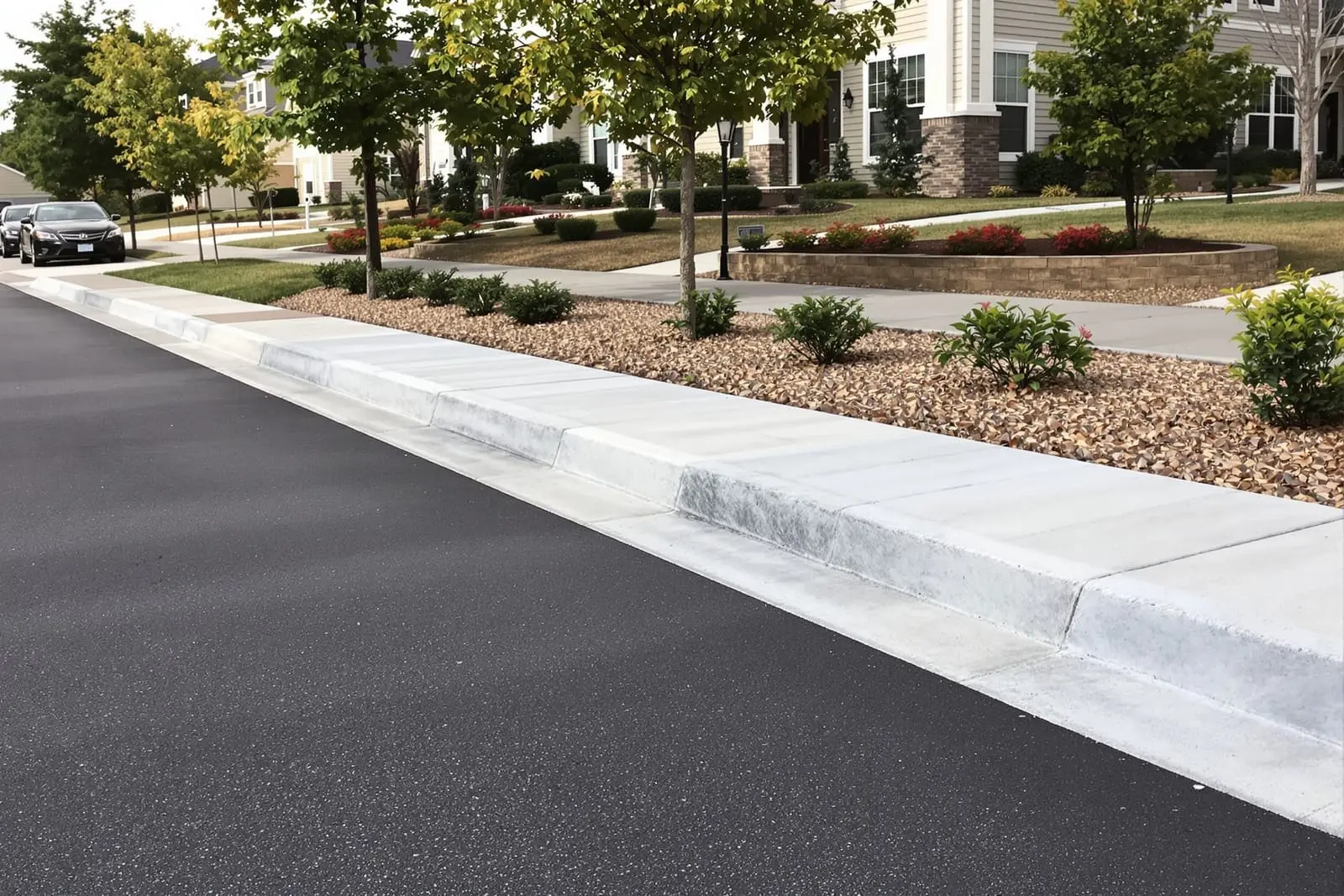
Control drainage and traffic with concrete curb and gutter installation in St Louis, MO. We form and pour continuous curbs for parking lots, streets, and drives. Concrete barriers and wheel stops help define safe vehicle areas. Complete your site design with durable concrete edge control.
Vanguard Concrete St. Louis provides professional concrete curb and gutter throughout St Louis, MO and the surrounding area. Our licensed, insured crew delivers safe, clean, on-time work with a free estimate before anything begins. Call (314) 788-2998 or request your free quote.
Practical Concrete Curb and Gutter Solutions in St Louis
Curbs, gutters, and concrete barriers are not glamorous projects, but in St Louis they matter a lot for controlling water, protecting pavement, and keeping vehicles where they belong. At Vanguard Concrete St. Louis we focus on practical, durable concrete curb and gutter systems that stand up to Midwestern freeze and thaw cycles and daily traffic, without making the process confusing or drawn out.
When you call us about a concrete curb and gutter project, the first thing we do is walk the site with you. We look at where water currently flows, where it ponds after a storm, how close you are to property lines, sidewalks, and entrances, and how vehicles actually move on and off the pavement. For commercial sites we also pay attention to delivery truck paths, dumpster locations, and drive entrances, because these are the spots that most often break down and need reinforced or modified curb sections.
Unlike generic contractors that treat every run of curb the same, Vanguard Concrete St. Louis designs around specific St Louis conditions: clay soils that hold water, older neighborhoods with mismatched elevations, and city or county requirements for curb height and gutter slope. We explain the options in normal language, show you where we recommend changes, and build a plan that fits how your property really functions in day to day use.
How We Install Concrete Curbs, Gutters, and Barriers
A solid concrete curb and gutter job starts with layout and excavation. We mark the new curb line with string and paint, then saw cut and remove existing pavement or crumbling curb where needed. Our crew excavates to the correct depth and width, usually 6 to 12 inches below finish grade depending on load and soil conditions. Soft or saturated subgrade is removed and replaced with compacted rock, which is critical in St Louis where pockets of soft clay can cause sections to settle and crack.
Next we set precise forms to create the shape of the curb and gutter. For standard curb and gutter, this typically means a 6 inch curb face with a 2 foot gutter pan, but for residential drive approaches or parking lot islands we may adjust these dimensions. We set forms to match existing pavement and entrances so you do not end up with unexpected bumps or dips. Getting this step right determines how water moves across your lot, so we double check slopes with levels and string lines, aiming for consistent fall toward storm inlets or safe discharge points.
Once the forms are in place, we place reinforcement if needed. Many city streets use plain concrete in curb and gutter, but for commercial entrances, dumpster pads, and barrier sections we often install rebar or wire mesh tied into adjacent pavement. This helps keep the curb and gutter from breaking away when heavy trucks turn or ride up on the edge. We then pour ready mix concrete, usually 4000 PSI or higher, air entrained for freeze and thaw durability.
While the concrete is still plastic, we rod and vibrate it to remove voids, strike it off for correct shape, and steel trowel or broom finish the exposed faces. Control joints are cut or tooled at set intervals to manage cracking. For curbs along driveways and sidewalks, we often apply a light broom finish on top surfaces for better traction in snow and ice. After finishing, we apply curing compound so the concrete gains strength evenly and is less prone to surface dusting or early shrinkage cracks.
Design Options and Common Local Use Cases
Concrete curb and gutter is not one size fits all, even within St Louis. Vanguard Concrete St. Louis helps you decide what profile and layout make sense based on the way people and vehicles use your property. For residential drives, we often install curb cuts with flared or rolled curbs that are easier to drive over and shovel along, while still guiding water toward the street. In older city neighborhoods with narrow streets, we can tie new curbs into existing limestone or brick edges so the repairs do not look out of place.
On commercial properties and industrial sites, we install a mix of barrier curbs (tall vertical faces), mountable curbs, and integral curb and gutter. Barrier curbs are common along building fronts, loading docks, and parking lot perimeters, where the main goal is to prevent vehicles from climbing over and hitting structures or pedestrians. In high impact areas we may thicken the base of the curb, increase concrete strength, or add rebar dowels into the slab or pavement behind it.
We also address specific St Louis drainage problems. Many calls we receive involve water running toward a building or pooling at low spots near entrances. In these situations we may recommend adding a concrete valley gutter across a drive lane, adjusting the gutter slope toward an existing inlet, or installing new catch basins that tie into storm piping. For alleys and rear parking lots, a simple concrete swale or modified gutter pan often solves recurring ice patches and springtime mud.
Finishing touches also matter. We discuss options such as integral color or pigmented sealer to make new curbs blend with existing pavement or match brand colors along retail storefronts. For busy pedestrian areas, we can add contrasting color or sawcut patterns at curb ramps to improve visibility without compromising drainage or ADA compliance.
What Affects Cost and Timeline for Concrete Curb and Gutter
Customers in St Louis often want to know why concrete curb and gutter pricing varies so much from job to job. Vanguard Concrete St. Louis is upfront about what actually drives cost and schedule. The first factor is removal and site conditions. If we need to saw cut thick asphalt or concrete, haul away large volumes of debris, or correct soft or saturated subgrade, that adds labor, disposal, and rock base. Tight access behind buildings and working around existing utilities or landscaping can also slow production.
The second factor is complexity of layout and forms. Straight runs with easy access are efficient to build. Curved islands, varying curb heights, and transitions into existing walks or aprons require more detailed form work and more time on site. If your project includes multiple types of curb (for example barrier curb along the front of the lot and mountable curb at drive entrances), we plan these details at the estimate stage so pricing is predictable and you understand why certain areas cost more.
Concrete specification is another cost driver. Standard residential curb and gutter can often use a 4000 PSI mix, but heavy duty loading zones, industrial yards, and bus routes may call for 4500 or 5000 PSI concrete, extra air entrainment, or fiber reinforcement. These upgrades cost more upfront but extend the life of the installation and reduce long term patching. We walk you through whether those upgrades are worth it for your site rather than automatically upselling.
Timeline is influenced by weather and curing requirements. In hot St Louis summers we schedule pours early in the day to avoid rapid surface drying and potential cracking. In colder months we may use blankets or cold weather additives to protect new curb and gutter from freezing. Most curbs can handle foot traffic within 24 hours, but we typically recommend waiting 5 to 7 days before allowing regular vehicle traffic, and even longer for repeated heavy truck loading. We will give you a clear traffic and access plan before we start, so your tenants, customers, or residents know what to expect.
What To Know Before You Hire a St Louis Curb and Gutter Contractor
Before you hire someone to install or replace concrete curb and gutter, it helps to understand how the work interacts with local codes, drainage rules, and existing infrastructure. In many areas of St Louis City and County, curb and gutter work that ties into public streets or storm inlets needs to follow specific standards for curb height, gutter width, and concrete class. Vanguard Concrete St. Louis is familiar with these details, and when the work involves public right of way we coordinate with the appropriate department so your project does not cause permit or inspection headaches later.
You should also ask any contractor how they plan to handle drainage. A curb and gutter that looks neat but sends water toward your building, neighbor, or sidewalk is a long term problem. We encourage property owners to walk the site with us during estimating and again after layout, so we can talk through where water will go, how high the finished curb will sit relative to door thresholds and pavement, and how snow plows or mowers will interact with the new concrete.
Another key point is expansion and transition details. On St Louis properties that mix old and new pavement, cracking often happens right where materials meet. We use dowels, joint sealants, and sometimes thickened edges to tie new curb and gutter into existing slabs in a way that allows movement without uncontrolled breaks. For barrier curbs that protect structures, we pay attention to foundation depth and backfill so the curb does not create a water trap or a weak point next to the building.
Finally, communication and phasing matter, especially at active businesses, multi family communities, and schools. Vanguard Concrete St. Louis can phase curb and gutter work so you keep at least part of your parking or drive access open, and we provide clear timelines for when each section will be closed and reopened. That way you can notify tenants and customers in advance, post temporary signs, and avoid last minute confusion while the new concrete cures and gains strength.
“
Professional curbs, gutters & concrete barriers, done right the first time, quality materials, honest pricing, and results that last.
Vanguard Concrete St. Louis
Curbs, Gutters & Concrete Barriers Across Our Service Area